
The Rann of Kutch: what to know before you go
The white salt desert is what draws people to Kutch. The artisans, the food and the homes are what they talk about afterwards. A practical guide to both.
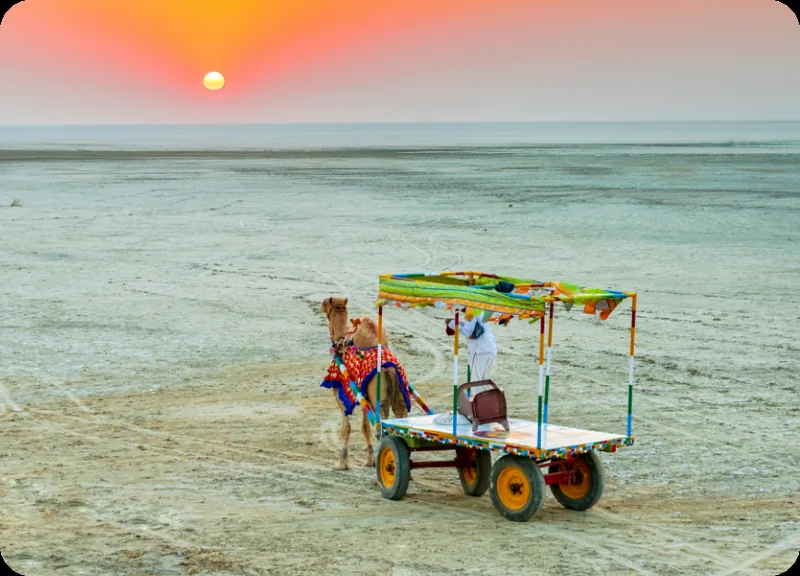
Most people come to Kutch for one image: a flat white horizon under a full moon, with no landmark in any direction. It deserves the reputation. But ask anyone who has travelled with us there what they remember, and the salt desert shares the answer with the family who hosted them in Bhuj and the artisans of Ajrakhpur.
Here is what is worth knowing before you go.
The Rann is seasonal, and that is not a detail
For much of the year the Rann is marshland. It becomes the white expanse people photograph only after the monsoon water evaporates and leaves the salt crust behind — roughly November through February, which is also when Rann Utsav runs and when the weather is kind.
Outside that window you can still visit Kutch, and the craft villages are open all year. You just should not expect the horizon from the photographs.
What the salt desert is actually like
Two things surprise most first-timers.
The first is the silence. With no vegetation and no structures, there is nothing for sound to reflect off. People tend to stop talking without deciding to.
The second is that it is genuinely disorienting. With no horizon line to judge distance against, things look much nearer than they are. Stay with your group and your Mentor — this is not a place to wander off in.
Go at sunset and stay for the moon if you can. The colour on the salt in the last twenty minutes of light is the thing photographs never quite hold.
Give the craft villages real time
This is the part visitors most often under-plan. Kutch is one of India's great textile regions, and the work is still done by families who have done it for generations.
- Ajrakhpur — Ajrakh block printing, a resist-dyeing process of many stages done entirely by hand. Watching it explains the price of the finished cloth better than any label could.
- Bhuj and around — embroidery traditions that differ village to village, distinct enough that practitioners can tell you where a piece came from.
- The markets — worth an unhurried afternoon rather than a scheduled hour.
Buy directly where you can. It is better cloth and the money goes where it should.
Practical things
- Layers, seriously. Desert days are warm and desert nights are cold, and the change is faster than you expect.
- Cover up at midday. White salt reflects sun from below as well as above — sunglasses matter more here than in most places.
- Closed shoes for the Rann. The crust is uneven and abrasive.
- Cash for the villages. Many artisans work without card facilities.
- Leave space in your bag. Nearly everyone buys more textile than planned.
The part nobody plans for
Our travellers went to Kutch for the White Rann and came home talking as much about the family who hosted them in Bhuj, the hospitality, and the hours spent watching a craft they had not known existed the week before.
Plan for the salt desert. Leave room for the rest of it.